Steven Soderbergh’s Kimi is in line with the filmmaker’s other paranoid thrillers of the past decade, Side Effects and Unsane, which both cast a skeptical gaze at the mental health industry. Here, though, Big Tech rather than Big Pharma plays the baddie in a plot centered around an imperiled young woman. But the fiercely and unapologetically intense Kimi also reflects another long-running Soderbergh interest, as it articulates the socio-political problems of omnipresent surveillance and alienated labor in the form of a taut, exciting chase through the already-dystopic spaces of our hypermediated society.
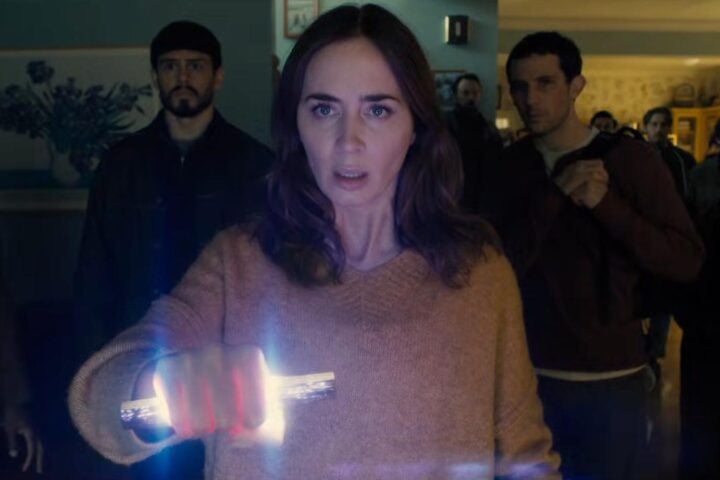
Trauma-hardened techie Angela Childs (Zoë Kravitz) is a low-level employee of the Amygdala Corporation—a name that at once feels a bit on the nose and just right for a digital media company with dystopian ambitions. Amygdala offers an Alexa-like device called Kimi, and as a selling point emphasizes that it uses humans like Angela, rather than algorithms, to screen and correct the errors detected in communication between Kimi and average consumers.
Angela does her work from her apartment in Seattle, which is ideal both because of the Covid-19 pandemic—this is the still-rare Hollywood production that not only acknowledges the ongoing pandemic, but makes dramatic hay with it—and because of her acute agoraphobia. Confined to her apartment by her disability, Angela’s situation inevitably evokes that of James Stewart’s hobbled photographer from Alfred Hitchcock’s Rear Window.
In a film full of clever maneuvers, though, Soderbergh’s navigation of familiar terrain is the cleverest. That familiarity is acknowledged off the bat with a montage of the windows facing Angela’s apartment, then defies expectation by becoming a representation of pandemic-era solidarity. In short, it’s not her equally nosy neighbors who Angela has to worry about.
Also, instead of witnessing a murder through window panes and curtains, she uncovers evidence of a crime even less directly: In a Kimi recording flagged as containing an error, barely audible beneath the strains of thumping electronic music, Angela thinks that she hears a woman being sexually assaulted. After a sequence of the young woman transferring files, plugging in apparatuses, and turning knobs to isolate the sounds of struggle (shades of The Conversation), she begins digging even deeper into Kimi’s deep databases, discovering a later recording of the woman’s death at the hands of coolly professional hired killers.

The first two acts of David Koepp’s economical script are set almost entirely in Angela’s apartment, and Soderbergh does wonders in lending dynamism to her spacious loft, using the camera to close it off and open it up as the drama demands. There can be a cold impersonality to the filmmaker’s aesthetics, but the presentation of space here is keenly dialed into Angela’s state of mind—except in those moments when the camera seems to adopt a critical distance. Atypical sweeping camera movements at narrative turning points and the playfully Bernard Hermann-esque ambient swells of Cliff Martinez’s score carry an intriguing alienating effect, working in productive counterpoint to the plot’s straightforward murder mystery.
Strategically recalling us from our identification with Angela serves to remind us that we’re supposed to also be thinking in bigger terms. While The Conversation plays out the ambiguity of recorded evidence, in Kimi the source of the tension is less in the fuzzy line between interpretation and fantasy and more in the moral unreliability of the institutional powers that be. Soderbergh’s film is less about ontological doubt regarding a recorded event plucked from the flow of reality than it is about corporate occlusion of the data stream to protect profit.
Soderbergh and Koepp don’t keep very close to their collective chest the fact that the man behind the rape and later contract killing is a higher-up at Amygdala, though Angela takes longer than we do to put the pieces together. The focus, then, turns to how the manifold institutions that interpenetrate life in the 21st century, from corporate employers to social media to law enforcement, don’t exist, as they might protest, to empower subjects to do more. Much the opposite. Perpetual surveillance and Big Tech’s cleanly ordered, Kafkaesque design methods serve above all else to create predictable pathways for maximum profit.
As a nervous, sweating Angela ventures out of her reclusion, the camera frenetically careens around her. It’s an anxious energy that doesn’t let up until the effective if somewhat pat conclusion that reminds of the prominence of another trope across Soderbergh’s canon: the resourceful, sardonic underdog. Kravitz’s embodiment of such a figure is further fleshed out, however, by her channeling of the psychologically frayed denizen of a society that’s suffered the impact of digitization, patriarchal capitalism, and a global pandemic. Angela is worn thin by the very isolation that’s nevertheless become the only kind of existence that she can bear.
If Soderbergh ever follows through on his repeated threats to retire, we might look back on him as one of our foremost pop chroniclers of the contemporary world. In Kimi, he and Koepp extend into impactful hyperbole the tensions inherent in the situation of being subjects of and subjects to incessant surveillance. Effective as a nail-biting thriller, the film ultimately lands with a jolt because it takes place in a world that we recognize at once as an unbearable cyberpunk dystopia and as, undeniably, the one we already live in.
Since 2001, we've brought you uncompromising, candid takes on the world of film, music, television, video games, theater, and more. Independently owned and operated publications like Slant have been hit hard in recent years, but we’re committed to keeping our content free and accessible—meaning no paywalls or fees.
If you like what we do, please consider subscribing to our Patreon or making a donation.