Nestled between the epic sprawl of the first two Godfather films, The Conversation allowed Francis Ford Coppola to engage in a more personal style of storytelling. With it, he crafted a small-scale character study steeped in minor-key melancholia, as well as gave free reign to his infatuation with the international arthouse cinema of the time.
A shout-out to Michelangelo Antonioni’s Blow-up, The Conversation perfectly encapsulates the disaffection, alienation, and paranoia infecting America’s body politic in the era of Watergate, the wiretapping scandal that brought down the Nixon administration, though the timing of the film’s release was coincidental. By some act of synchronicity, Coppola opted to focus on a surveillance expert, Harry Caul (Gene Hackman at his most buttoned-up), who utilizes the same sort of hardware as G. Gordon Liddy and the other Watergate “plumbers” while in the employ of a corporate bigwig known only as the Director (an uncredited Robert Duvall).
Harry’s assignment is to record a conversation between a young couple, Ann (Cindy Williams) and Mark (Frederick Forrest), as they nervously perambulate around San Francisco’s Union Square. Throughout, Coppola and cinematographer Bill Butler use long lenses and extreme zooms to mirror the surveillance team’s state-of-the-art equipment, an aesthetic choice that continues in the often static, passively observational camera placement during later scenes.
The opening shot is one of these slow zooms that moves down from a God’s-eye view of Union Square. (Haskell Wexler was the film’s original cinematographer, and his footage was reshot except for surveillance scene in the plaza.) Only later will the viewer realize that it stands in for the POV of a boom-mike operator, eerily resembling the lone gunman in yet another political assassination scenario, perched atop a nearby building. But The Conversation largely eschews the overtly political, burrowing down deep into the quagmire of personal relationships.
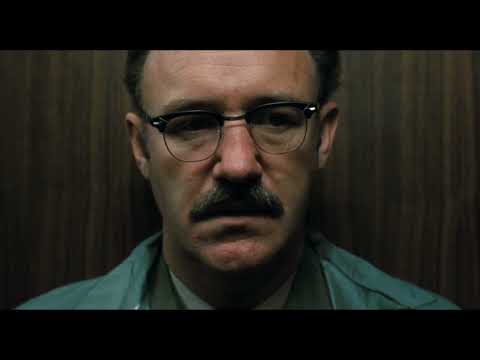
At the outset, Harry, the consummate professional, claims that he couldn’t care less about the conversation’s content, as he’s interested only in getting a “nice, fat recording,” made possible by his formal and technical prowess. As Coppola’s film progresses, though, it’s increasingly apparent that the man’s restraint, a desperate feint at objectivity, stems from a profoundly traumatic source, the murderous upshot of one of Harry’s earlier assignments.
Consequently, Harry has insulated himself from any encroachments of human fellowship. Rather than professionalism, a sense of responsibility and guilt emerges as Harry’s prime motivator. Coppola brilliantly aligns these concerns in a brief scene where Harry goes to confession, the only space in seems in which he can truly open up. As he expresses his darkest fears, the camera executes a slow rack focus from Harry’s profile to the confessional booth’s screen, then through to the ear of the priest hearing his confession.
The confessional booth’s screen is another in The Conversation’s diaphanous surfaces that simultaneously hide and reveal. Further instances include the sheet of plastic hanging in Harry’s warehouse office sanctum, the glass partition between balconies at the Jack Tar Hotel, and the clear raincoat that Harry always wears, regardless of the weather’s clemency. Add to that the fact that “caul” refers to an amniotic membrane that sometime covers a newborn’s head, often linked in folklore traditions to prophetic powers. This accounts for Harry’s strange dream in which he sees Mark and Ann being murdered by the Director. But considering the actual outcome of events, Harry’s vision is given an ironic final turn of the screw.
“Who started this conversation anyhow?” Mark asks at one point during one of his peregrinations with Ann. Their dialogue is reiterated throughout the film, as Harry fills in its blank spots, and each time parts of it take on new meaning. One line, in particular, signals radically different consequences depending upon its intonation. In a larger sense, repetition serves as The Conversation’s thematic keystone. Harry acts to prevent the same thing happening again as a result of his work, inadvertently contributing to the certainty that it will.
Image/Sound
The Conversation looks and—even more important, given the film’s fixation on all things aural—sounds pristine. Several transitional shots are soft and, especially in the opening Union Square scene and all its reiterated flashbacks, grainy, but this is part and parcel of Francis Ford Coppola’s utilization of long lenses and zooms to mimic the technologies then available to surveillance experts. As well, the crowded opening scene registers the strongest sonically, with voices darting in from surrounding tracks and phasing nicely from speaker to speaker, providing for a wonderfully immersive repurposed 5.1 track. The lossless 2.0 track is, of course, closer to the original theatrical experience, but you owe it to yourself to sample the remix.
Extras
Coppola’s commentary track is an essential listen, a personal and ruminative assessment of The Conversation’s background and production, its formative influences (in addition to the obvious, Antonioni’s Blow-up, Coppola mentions Hermann Hesse’s Steppenwolf as a literary antecedent for Harry Caul, and Tennessee Williams’s blend of prose and prosody in his plays), as well as Coppola’s take on his career-long desire to balance the heft and even bombast of his larger canvases (the Godfather trilogy, Apocalypse Now) with smaller films like The Conversation. Editor and sound designer Walter Murch’s commentary track is also worthwhile from a technical standpoint, even if it contains much more dead air and downtime.
All the supplemental features, many new to the Blu-ray package, are presented in HD (or, in the case of Coppola discussing his early “film exercise” No Cigar over footage from the short, in 1080i). In addition to this cursory discussion of the “lonely man” theme that Coppola sees as a link between No Cigar and The Conversation, there’s a slideshow that compares shooting locations then and now, an interview between Coppola and composer David Shire that reveals the amusing tidbit that Coppola, Murch, Shire, and casting director Fred Roos all fell asleep during their initial screening of the film, archival screen tests for Cindy Williams and Harrison Ford, and excerpts from Coppola’s dictation of the script’s first draft into a tape recorder. Aside from Coppola’s commentary, this is easily the most fascinating supplement, since these extracts reveal his initial vision for a vastly different climax and conclusion.
As intriguing as these changes are, though, they would have made for a simpler, more tidily resolved film, closer in mood and structure to an extended episode of Alfred Hitchcock Presents. A very short (and technically messy) on-set interview with Gene Hackman doesn’t allow Hackman to delve very deep into playing Harry Caul, what with all the interruptions for clapboards and sound drop-outs. Finally, there’s a vintage featurette, “Close-up on The Conversation,” that contains a bit more on-set interview with Hackman and Coppola and shows the two men rehearsing a key scene.
Overall
Listening in on The Conversation has never been so rewarding, thanks to Lionsgate’s stunning new 1080p transfer and wealth of extras, both old and new.
Since 2001, we've brought you uncompromising, candid takes on the world of film, music, television, video games, theater, and more. Independently owned and operated publications like Slant have been hit hard in recent years, but we’re committed to keeping our content free and accessible—meaning no paywalls or fees.
If you like what we do, please consider subscribing to our Patreon or making a donation.