Many of Pixar’s recent films are tightly constructed, cleverly written, and appealingly designed, but also a tad underwhelming. And one possible rule of thumb for distinguishing the transcendent wheat from the merely entertaining chaff is if the plot involves a character transforming into an animal (mostly) against their will. The repetition of this device gives the impression that Turning Red, like Brave, Soul, and Luca before it, is retreading familiar ground even as it recontextualizes its bodily metamorphosis.
Domee Shi’s film is set in 2002, if for no other reason to justify its tweenage characters’ especially ardent boy-band fever and the symbolic presence of a Tamagotchi. Our main character is Mei Lee (Rosalie Chiang), a 13-year-old of Chinese heritage who’s undoubtedly, in age-appropriate parlance, fierce. An opening montage accompanied by her voiceover narration gives us a flash-bang overview of her life: her closeness with her parents—Ming (Sandra Oh) and Jin (Orion Lee)—that she identifies as rooted in Chinese tradition, her assertive presence in class, and the tight-knit friend group she’s begun to gab about boys with.
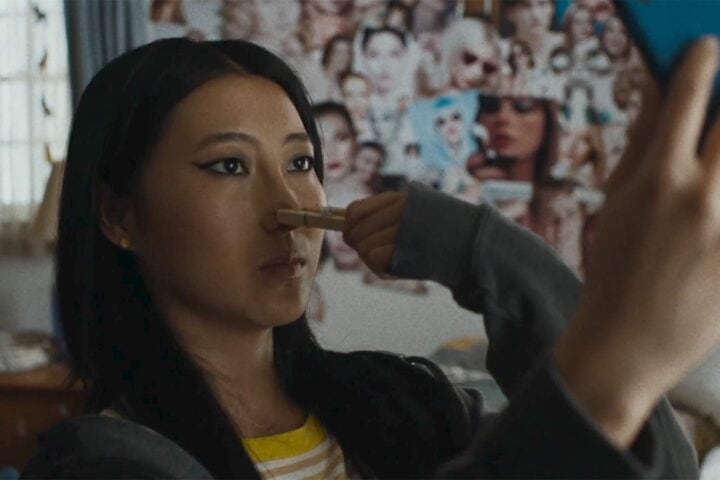
Mei’s burgeoning independence and sexuality come into conflict with the expectations of her home life, which is dominated by her mother. In an early scene, Ming discovers Mei’s drawings of a local convenience store clerk in whom she develops a crush, and instead of recognizing her daughter’s Mei’s desire as fundamentally innocent, she confronts the boy at work with Mei’s sketches, as if he were to blame for the girl’s idle fantasies. Mei goes to bed mortified and infuriated and, the next day, wakes up to find herself transmogrified into a giant red panda.
Mei is mortified by her new appearance, but Turning Red is hardly The Metamorphosis, in part because the panda’s level of adorableness is much higher than that of a monstrous insect, and in part because Mei finds that she’s able to return to human form by centering herself. (Mei’s family owns and operates a temple—whose spirit animal is the red panda—adjacent to their Toronto home.) Her best friends—Miriam (Ava Morse), Priya (Maitreyi Ramakrishnan), and Abby (Hyein Park)—not only accept the cute but imposing panda as a new facet of Mei, but they also hatch a plan to charge their classmates for the panda to appear at parties, with the goal of making enough money to see their beloved boy band 4*TOWN in concert.
Related Story
Every Pixar Movie Ranked
Unsurprisingly, Mei’s transformative abilities turn out to be a mystical family inheritance. Her parents reveal that there’s a ritual that will suppress the panda, which can be performed on the night of the next “red moon.” Perhaps pre-empting charges that the symbolism is a bit too heavy handed, Turning Red overtly acknowledges the parallels between its scenario and a girl’s first period. Ming initially misunderstands the reason for her embarrassed daughter waking up and locking herself in the bathroom, and continues her pattern of helicopter-parenting her by showing up outside of school to deliver the menstrual pads that the girl left at home.
The strongest point of Turning Red is the way it depicts a mother-daughter relationship that’s at once culturally specific and widely relatable. Ming might be read as skirting close to the “tiger mom” stereotype, but the film, co-written by Shi and Julia Cho, humanizes her with personality quirks and clear motivation that defy that sloganized interpretation of Asian parenting. Brought to life by Sandra Oh’s limber vocal performance, Ming can be both stern and warm, imposing and goofy, and her over-protection is rooted at least as much in her own feelings and personal history as it is in Chinese traditions of filial piety.
But as compelling and unique a relationship as it draws between Mei and her mother, Turning Read turns increasingly plodding as it progresses. The culture clash embodied in the mother-daughter tension leads, after some sitcom-esque “sneak out to party” hijinks, to a rather uninspired battle between giant pandas that seems like it could have been taken out of the latest Marvel extravaganza. The metaphor of adolescent change and rebellion was perhaps a bit overworked even before it culminates in an extended, high-energy climax at the 4*TOWN concert in which the action feels less motivated by the characters’ feelings than it does by heavy-handed symbolism and the commercial value of combat between super-beings.
This unnecessarily spectacular finish isn’t the only point where it’s difficult to see Turning Red as doing much more than fabricating appeal by adopting current trends. Although the film is set in the age of digital camcorders and landlines, it cultivates a TikTok aesthetic throughout, with its snappy, emphatic humor, its intensified editing pace, and its adoration of all things cute. When a group of girls at school first see Mei in her panda form, their eyes widen and glisten in claustrophobic close-up, becoming, in their parody of Zoomers’ enthusiasm for anything with big eyes and fur, memeable cute things themselves.
The film’s translation of the tumult that mothers and their teen daughters experience into the fantastical language of animation marks something of a landmark in the Pixar canon. But after a first hour that may well hit Zoomers and their millennial parents in the feels, Turning Red gradually runs out of steam, its metaphor stretched thin and its plot turning in place.
Since 2001, we've brought you uncompromising, candid takes on the world of film, music, television, video games, theater, and more. Independently owned and operated publications like Slant have been hit hard in recent years, but we’re committed to keeping our content free and accessible—meaning no paywalls or fees.
If you like what we do, please consider subscribing to our Patreon or making a donation.