Derek Jarman’s The Garden is an elemental film. Throughout, the director returns to images of the four classical elements—fire, water, earth, and air—as if the film were trying to give birth to a new world, as if it were a world itself. And, beyond the biblical allusion, perhaps that’s what the title of his hallucinatory film refers to. Gardens are microcosms, life-giving gatherings of water, earth, and air—and fire as well, if you so happen, like many of the film’s characters, to be holding a signal flare while standing in your garden.
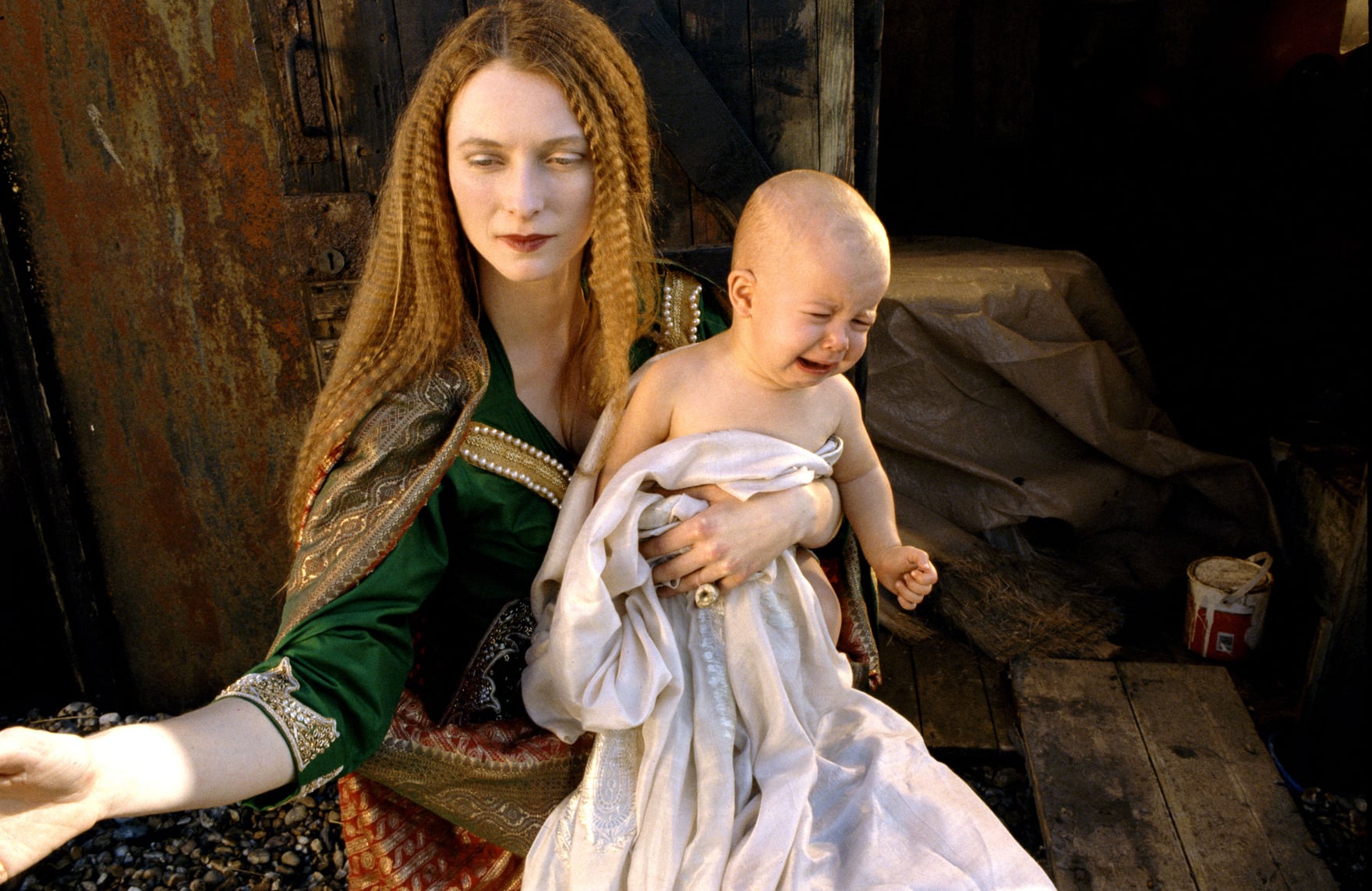
The film’s lo-fi, Super 8 images, through the use of color filters and compositing effects, evoke a trajectory of paradise lost and innocence persecuted. Jarman queers the parables of the Bible, envisioning the devil as a leather daddy (Pete Lee-Wilson), the 12 apostles as middle-aged women in headscarves, Mary Magdalene and Adam as a drag queen (Spencer Leigh), and Jesus as a gay couple (Johnny Mills and Philip MacDonald), or, in some scenes, as Jarman himself. And the filmmaker’s muse, Tilda Swinton, is on hand as the Madonna, a skull-cap-wearing desert wanderer who suggests an embodiment of Mother Nature herself.
A voiceover narration, written by Jarman and read in the elegant voice of Michael Gough, warns us that The Garden will not be interested in conclusions, and this elliptical film also proves uninterested in conclusiveness. “I want to share this wilderness of failure,” Gough intones, and by degrees we gather the wilderness he refers to is both the world in toto and the one the gay community has been abandoned to. At the end, as the martyred gay couple—we’ve seen them go through a modern 12 stations of the cross—sit down to a mournful gathering with the rest of the main cast, Gough speaks poetically of the lives lost to the AIDS epidemic: “Old age came quickly for my frosted generation. Cold, cold cold: They died so silently.”
Jarman himself had been diagnosed with HIV in 1988, and he would succumb to AIDS in 1994. The Garden is in part his cry of rage and frustration, at the continued persecution of gay men and above all at the way they had been abandoned during the AIDS crisis. Early on, Swinton lets out a scream of anguish that reverberates throughout the entire film, tinging even its beauty and its moments of playful camp with an ominous overtone. A hopeless cynicism is also palpable in a scene in which an executed Judas, hanging by the neck with his tongue protruding, is used to sell credit cards, a slimy suit-clad man hawking a handful of the plastic cards directly to the camera while Judas’s body swings in the background.
And yet, despite being guided by a dream logic that’s nightmarish more often than not, the film isn’t oppressive. Jarman appears in a few roles, including that of a dreamer, asleep on a bed in a shallow sea as white-linen clad figures circle around him holding flares. The Garden doesn’t foreclose the dream of a more serene world. Jarman’s manipulation of the low-grade film stock draws out flickering oranges and reds from shots of the sky over a gray beach, and Gough often speaks over close-ups on flames. The film’s images burn, yet Jarman understands that fire can symbolize both destruction and creation. After all, one burns the vestiges of last year’s crops before replanting, and The Garden isn’t without hope that we can regrow a paradise. A scene featuring the film’s central, unnamed gay couple—one is tempted to call them “eternal”—wearing pink tuxedos and holding an infant maintains the possibility of a different reality, one in which anti-gay hate has finally been snuffed out.
Since 2001, we've brought you uncompromising, candid takes on the world of film, music, television, video games, theater, and more. Independently owned and operated publications like Slant have been hit hard in recent years, but we’re committed to keeping our content free and accessible—meaning no paywalls or fees.
If you like what we do, please consider subscribing to our Patreon or making a donation.