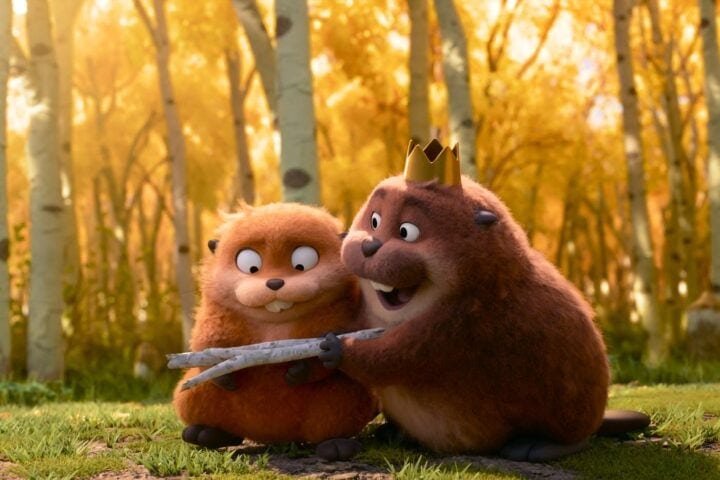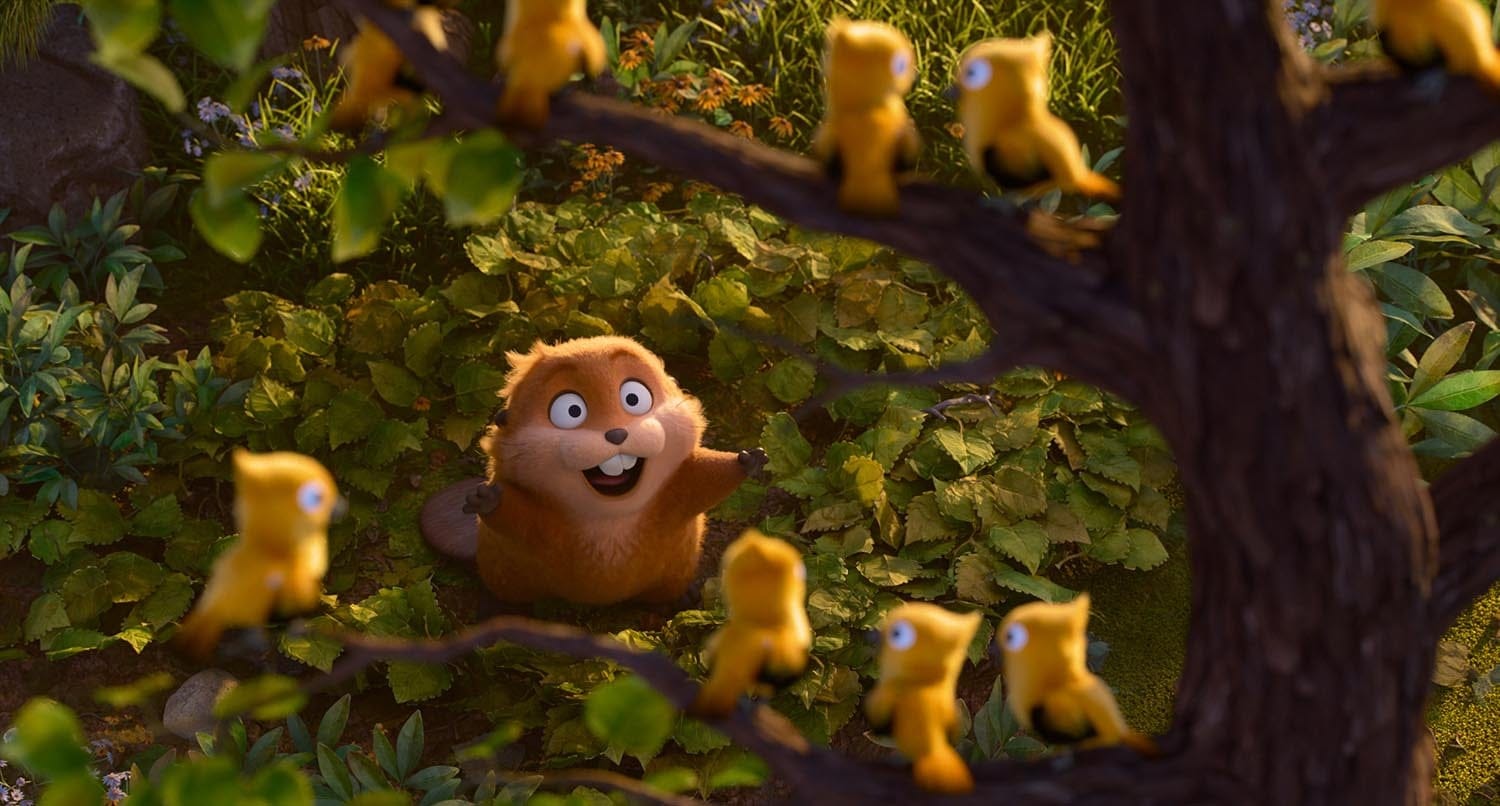
Pixar’s Hoppers hypothesizes a clash of nature and capitalist modernity in more literal and extreme terms than any prior film by the studio. Pitting industrial expansion against the natural ecosystems it threatens to displace, the film is a riff on Avatar by way of Pom Poko that tries to match a moment of national division and self-doubt by weaving together questions of environmental struggle, indigenous rights, and the utility of political violence. It’s also one of Pixar’s most manic works to date, a cavalcade of shouting, slapstick, indistinct funny faces, big loud action and dancing beats, chaotic plot swerves, and jokes about animals using emojis. Unsurprisingly, this makes for a confused fit with the story’s themes.
Daniel Chong’s film revolves around Mabel Tanaka (Piper Curda), an undergrad eco-warrior growing up in the suburb of Beaverton. Her zeal for defending the natural world from human exploitation tends to put her at odds with everyone except her sage grandmother (Karen Huie), who advises her to let a sense of oneness with nature override her impatience with less sensitive humans. When the town’s popular mayor, Jerry (Jon Hamm), declares his intent to destroy Mabel’s favorite glade to make room for an overpass, her pleas for dialogue go unheard.
Mabel’s tree-hugging (or beaver dam-hugging) protest methods amount to little more than a nuisance for the powerful, and her attempts at rallying democratic change are stymied by an indifferent public. Even nature seems to have given up: The beavers have mysteriously abandoned the glade, and without their presence the ecosystem fades.
Mabel’s fortunes change when she discovers her environmental sciences professor, Dr. Sam (Kathy Najimy), experimenting with a revolutionary new technology: a way to stream a human consciousness into a robotic animal body and communicate with animals in their native environment. It’s indicative of the film’s idea of wit, and Disney corporate synergy, that Mabel must immediately point out that “this is just like Avatar!”
Immediately upon mindjacking a robot beaver and escaping into the wild, Mabel makes an astonishing and implausible discovery: The beavers, birds, fish, deer, bears and more are all intelligent, speak a common language, enjoy dancing to Loverboy singles, and are politically organized into kingdoms. King George (Bobby Moynihan), the beaver monarch of the glade, is an easygoing and softhearted figure who believes in nonviolence and limitless understanding; his utopian “Pond Rules” include the consent of herbivores to be hunted and eaten at will by their superiors on the food chain, which everyone seems quite nonchalant about.

Mabel’s efforts to inspire revolutionary consciousness in the docile woodland animals, though, work too well. They soon begin plotting to fight back the encroachment on their land by slaughtering the humans, starting with Mayor Jerry, sending our heroine’s allegiances careening in the opposite direction as she struggles to bring about a nonviolent resolution.
Chong and Jesse Andrews’s script is hectic, laying on chatty world-building that only becomes less coherent the more of it there is: When is killing animals a big deal and when is it not? It falls well short of providing any satisfying exploration of its weighty theme of persuasion versus violence in the face of oppression. Characters’ goals and motivations change every few minutes as more and more characters and plot elements are introduced—often by way of characters sardonically explaining recent events, to the effect of “Wow, that just happened.” Eventually, the film manages to contort itself through a confrontation with an 11th-hour villain to arrive at a Disney-friendly platitude as disconnected from reality as its intra-species politics.
Perhaps more surprisingly, the film is regressive artistically as well as politically. Every animal, robot or otherwise, has a stocky toyetic body with the same beady, googly eyed face, suggesting the crude style of a Tumblr webcomic with the stylistically jerky character motions of Chong’s Cartoon Network fare. Yet Pixar, the top 3D animation studio in the world, must simultaneously show off its technological advancements in texture and lighting, leading to the uncanny image of broadly caricatured cartoon animals and people with lifelike fur and flesh, like an antique doll with detailed skin—too real to be an evocation, too crude an abstraction to seem real.
Kids won’t complain, and indeed, the film’s hour and 45 minutes of sustained color, noise, and low-hanging jokes about animals behaving like people aren’t the worst time their accompanying adults could have at the theater. But taken altogether, this messy, confused film is a clear illustration of Pixar’s decline from its high-concept glory days, when the uncanny—say, a glossy factory-produced toy’s vantage point on the U.S.—could produce humor, whimsy, and social self-reflection that wasn’t too effortful to actually reflect anything.
Since 2001, we've brought you uncompromising, candid takes on the world of film, music, television, video games, theater, and more. Independently owned and operated publications like Slant have been hit hard in recent years, but we’re committed to keeping our content free and accessible—meaning no paywalls or fees.
If you like what we do, please consider subscribing to our Patreon or making a donation.