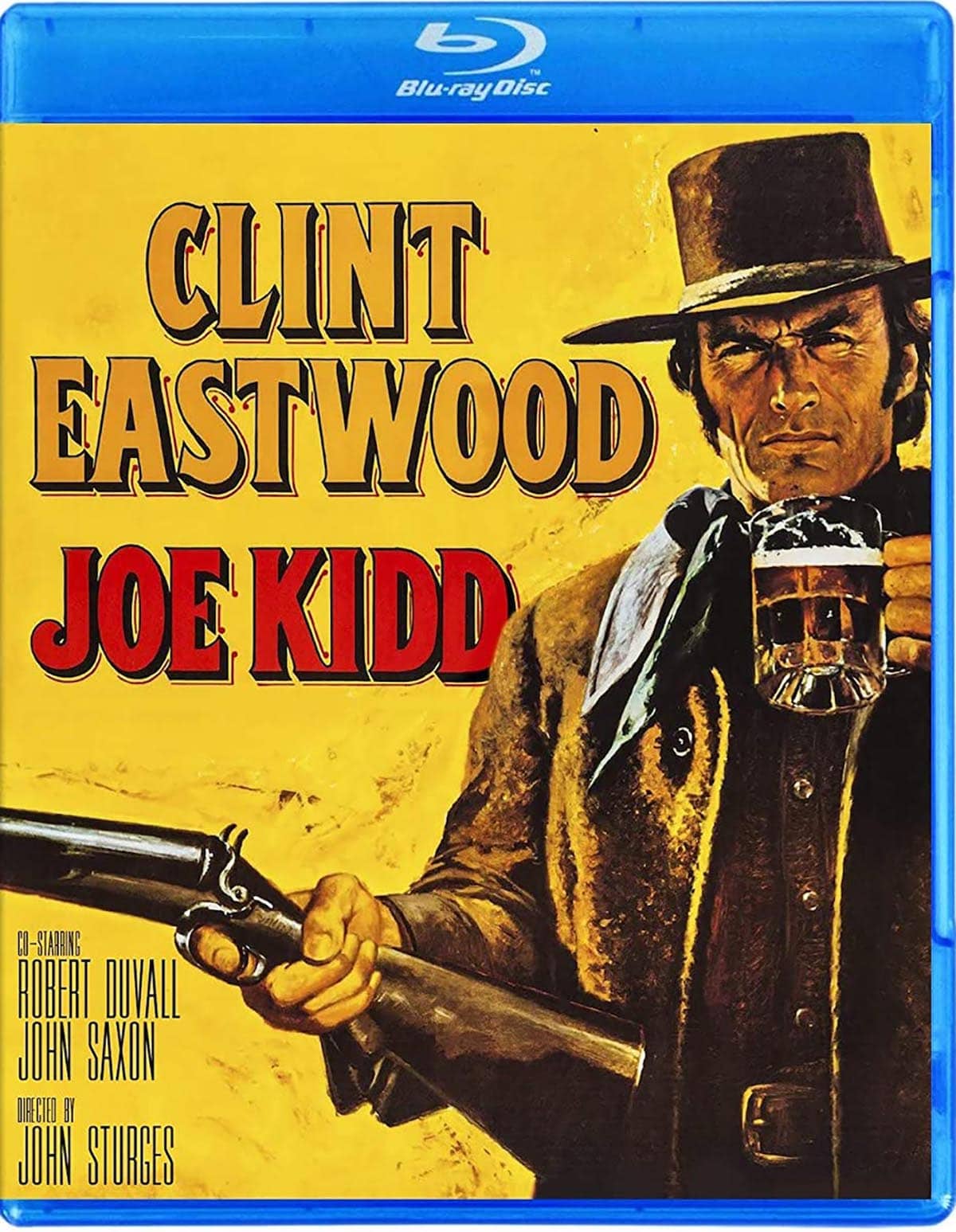
 On the face of it, bringing together John Sturges, who had helmed top-shelf westerns like Bad Day at Black Rock and The Magnificent Seven, and iconic star Clint Eastwood, fresh off his directorial debut Play Misty for Me
, would seem like a match made in genre heaven. But 1972’s Joe Kidd definitely provides a test case for the auteur theory. Because Eastwood, whose production company Malpaso was behind the film, was calling the shots behind the scenes, not to mention assembling a crackerjack crew who would go on to work with him again on his first western as a director, the following year’s High Plains Drifter. Unsurprisingly, this tug of war for control of Joe Kidd led to persistent tensions on the set, no doubt accounting for the alternating currents of slam-bang action and a draggy feeling of lassitude that run throughout the film.
It’s apparent from the opening scenes that Eastwood, as Joe Kidd, is trying to add a new wrinkle to his steely-eyed persona. We first meet Kidd in jail, doing time for poaching on Native American land in the small town of Sinola, New Mexico, and resembling nothing so much as a country bumpkin with his ill-fitting bowler hat and half-sprung celluloid collar. But this is far from a comedic turn for Eastwood. We soon discover that Kidd is a former bounty hunter turned moderately successful rancher. And from brief flashes of violence early on—like the way he nonchalantly tosses a man down a flight of stairs by his belt buckle—we surmise that he’s still more than capable of sudden action. But the film rather perversely keeps placing him in one situation after another that defer that action until the final half hour.
As scripted by Elmore Leonard, the storyline involves a posse, led by wealthy and ruthless landowner Frank Harlan (Robert Duvall), who recruit Kidd to track down renegade bandito and wannabe revolutionary land reformer Luis Chama (John Saxon). Along the way, Harlan takes advantage of every opportunity to display how inflexible and downright brutal he can be, aided in no small measure by a trio of cronies armed with newfangled weaponry like a long-range rifle and an automatic Mauser pistol. These technological advantages allow them to kill with impunity from a great distance, and the film demonstrates their cold-blooded efficiency in ways that are reminiscent of other westerns like Edwin Sherin’s Valdez Is Coming, which was based on a story by Leonard, and Don Medford’s grim and ultraviolent The Hunting Party.
Ostensibly the underdogs that the audience would ordinarily be rooting for, Chama and his band show themselves to be prone to gratuitous acts of cruelty, like tying a man to a post with barbed wire, proving little better than Harlan and his thugs when balanced on the scales of conventional morality. Chama, for his part, is an egomaniacal messianic type, content to sacrifice the lives of innocent peasants so long as it ensures his own continued existence. This makes his abrupt about-face so difficult to believe, when, out of nowhere, he decides to accept Kidd’s advice about turning himself over to the representatives of law and order whose authority he so vehemently (and, arguably, correctly) questioned earlier in the film.
That very notion of “justice for all” figures prominently in Joe Kidd’s climax. Just after the surreal sight of a locomotive crashing through several buildings, the final showdown between Kidd and Frank takes place in the very courtroom where the former was arraigned earlier in the film. Now Kidd occupies the judge’s chair, gun rather than gavel in hand. Sentence is passed with a single shot. Ultimately, Sturges’s film argues not in favor of self-interested establishment justice, nor the rights of a hardscrabble bunch of radicalized peasants, but instead for the justice of the six-shooter in the hands of a righteous man, neatly aligning Joe Kiss with Eastwood’s previous film, Don Siegel’s vigilante apologia Dirty Harry.
Image/Sound
Kino’s 1080p transfer of Joe Kidd looks terrific, capturing Bruce Surtees’s evocative cinematography in all its painterly, magic-hour glory. Colors are bright and densely saturated, flesh tones lifelike, and grain levels well-managed. The image reveals some real depth and excellent contrast. Kino use a two-channel Master Audio track that’s clean and clear, and places significant emphasis on Lalo Schifrin’s unfortunately rather middling score.
Extras
Filmmaker and author Alex Cox provides an authoritative commentary, albeit one that starts off a bit slow and seems on occasion out of sync with the on-screen events. Cox touches on the location shooting at Old Tucson and Lone Pine, California; the talented constellation of crew members that Clint Eastwood would work with again on his directorial projects; elements that Cox feels don’t particularly work in the film’s favor; and lots of comparisons between Joe Kidd and other westerns foreign and domestic. He’s particular astute when pointing out visual and narrative links to Sergio Corbucci’s masterful Italian western The Great Silence, including a tidbit about how Fox held up the film’s American release so that Eastwood could both direct and star in a remake that never actually happened. In an on-camera interview, actor Don Stroud discusses getting the role in Joe Kidd after working with Eastwood on Don Siegel’s Coogan’s Bluff, the fractious relationship between director John Sturges and Eastwood, working with other cast and crew members, and filming his unusual death scene.
Overall
Joe Kidd ambles onto Blu-ray with an exemplary transfer and a couple of interesting extras.
Since 2001, we've brought you uncompromising, candid takes on the world of film, music, television, video games, theater, and more. Independently owned and operated publications like Slant have been hit hard in recent years, but we’re committed to keeping our content free and accessible—meaning no paywalls or fees.
If you like what we do, please consider subscribing to our Patreon or making a donation.