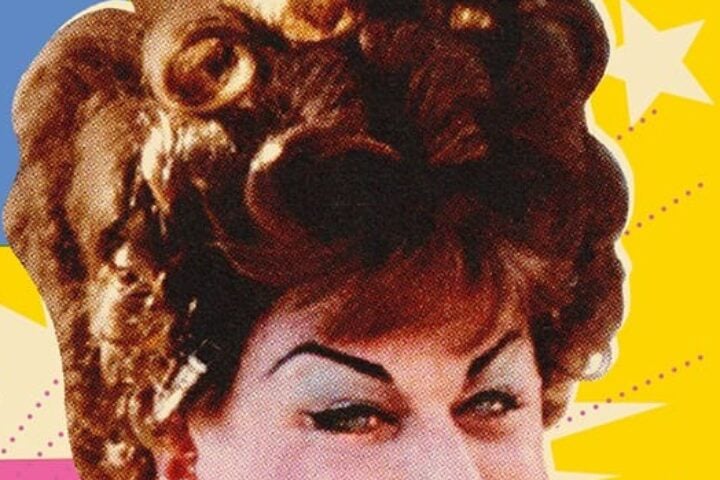
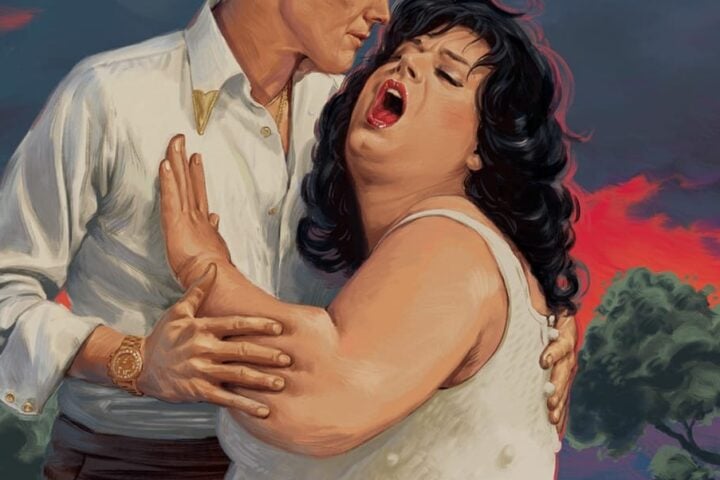
 As noted in the liner notes of the Criterion Collection’s release of John Waters’s Pink Flamingos, Divine’s signature look in the film came about primarily as a means of scaring hippies. Appearing earlier in Multiple Maniacs—and, immediately thereafter, in the first half of Female Trouble—like some mutant parody of Elizabeth Taylor, Divine here sports eyebrows so high they appear to be supporting the roots-revealing bump of hair at the top of her scalp, and her lips are drawn so as to appear pulled back in a perpetual, feral snarl. (In the film’s notorious coprophagous climax, one is less surprised to see Divine chow down on a fresh pile of dog doo than one would be to see the pile of shit sprout legs and run in horror from its soon-to-be consumer.)
All of which is to say that, despite its reputation as a landmark in outsider art, Pink Flamingos could—50 years after its release—just as easily be interpreted (or rather misinterpreted) as a proto-punk albeit latently conservative urtext. Or at least it feels so in our endlessly topsy-turvy waking nightmare of the alt-right positioning itself firmly in the role of America’s new counterculture, a development that this film’s furiously insurgent energy seems to anticipate.
Pink Flamingos depicts the Wagnerian cycle of struggle between two ersatz matriarchs for the title of “the filthiest person alive.” In one corner is the defending champion, Divine (under the assumed name Babs Johnson). In the other corner is Connie Marble (long-standing Dreamland player Mink Stole), who with her husband, Raymond (David Lochary), imprisons and impregnates young women in order to sell their babies on the black market.
Connie and Raymond are, in comparison to Divine and her clan’s transient existence living out of a sparsely appointed trailer, firmly upper-middle class, or the equivalent thereof in Waters’s version of Baltimore. The Marbles employ a manservant, Channing (Channing Wilroy), who also supplies the seed that they use to impregnate their captives, and they’re successful business moguls (like Polyester’s Elmer Fishpaw, they’re in the porn racket). And though Raymond’s side hustle sees him flashing young women and then robbing them, his own sensibilities are notably offended when he’s one-upped by a trans flasher.
From this side of American history, post-Moral Majority, one almost can’t help but observe Divine’s loving relationships with her cradle-ridden mother, Edie (Edith Massey, cinema’s all-time greatest discovery, no discussion allowed), and her chicken-humping son, Crackers (Danny Mills), as something akin to “family values.” And that her antagonists, the Marbles, may be more flagrantly breaking laws, if not socials mores, but hey, at least they’re working ahead of their time for LGBTQ rights—they only sell their babies to lesbian couples.
Of course, every battle in their filth war is quite obviously filtered through Waters’s legendarily up-is-down, wrong-is-right sense of humor. Ideology is but one of the many tools that the filmmaker uses in his full-court assault on propriety and good taste, even if at this transitional, yes, but also quite early point in his career that he was still very much focused on checking items off the list of atrocities from his warped mind. Castration, animal mutilation, media-observed murder, spontaneous incest, feces delivered via USPS, egg-slurping senior citizens, steak warmed up in Divine’s “own little oven,” and a lip-syncing anus. Pink Flamingos is less a political statement than it is a glorious menu of depravity.
In other words, the joke isn’t that Divine and her birthday guests are “sticking it to the pigs” when they attack and kill the cops that arrive to shut down their party; it’s that they’re chopping them up with her birthday gift—a meat cleaver—and consuming their meat in an orgy of De Sadeian ribaldry. Waters would develop more sophisticated interminglings between the manner and the matter of his films soon enough (one film later, in fact). For now and forever, it’s more than enough that he spent an hour and a half and the $12,000 filming budget laying out one of the most compelling foundational mission statements in the history of midnight movies, a landmark American anti-cultural declaration.
Image/Sound
Considering the acts it depicts, exactly how good do you want this film to look? Well, too bad. Pink Flamingos looks amazing in Criterion’s new 4K restoration. (The disc, to be clear, is only Blu-ray, not UHD.) The grain and grime of the film will make you want to take a bottle of Windex to your TV once it’s done, and the color balance underlines its “found object” mise-en-scene. This is the embodiment of spit-shining a turd. The uncompressed monaural sound is, as with Criterion’s efforts on Multiple Maniacs and Female Trouble, tinny, muffled, screechy, and perfect. All efforts to retain the integrity (sic) of Pink Flamingos is on full display here.
Extras
Not once has Criterion dropped the ball, and the home video bastion’s clear reverence for the Prince of Puke shines throughout this set in particular. There’s not one but two commentary tracks with John Waters, who’s undoubtedly up their with the best speaking extemporaneously on his or anyone else’s films. The first track comes from the ’90s Criterion laserdisc, and the second from the 2001 DVD release. Both are essential, and if you’re like me you’ll probably find it difficult to watch the film without one of the two running in the background.
Sweeting the pot is Steve Yeager’s 1998 documentary Divine Trash, an invaluable guided tour through the early years of Waters’s Dreamlanders, with vital interviews from key players including Mink Stole, who one Letterboxd user rightly declared appears as though she’s being interviewed in prison, with her orange jumpsuit blouse. The 97-minute documentary also serves up crucial footage of Waters’s troupe in the full bloom of bratty youth.
On the opposite end of the spectrum is a conversation between current-day elder imp Waters and struggling stoic Jim Jarmusch, who comes admirably close to coming off like someone who could get genuine pleasure from a John Waters film. Even better is a featurette in which Waters shows up to the locations of both the land where the Babs Johnson trailer was once parked and the house where the Marbles conducted their shady business. It’s not tough to share a thrill with the lucky folks residing in both locales as they follow Waters down memory lane. Each time Waters leans in with a “Can you imagine?” is a dream vicariously coming true.
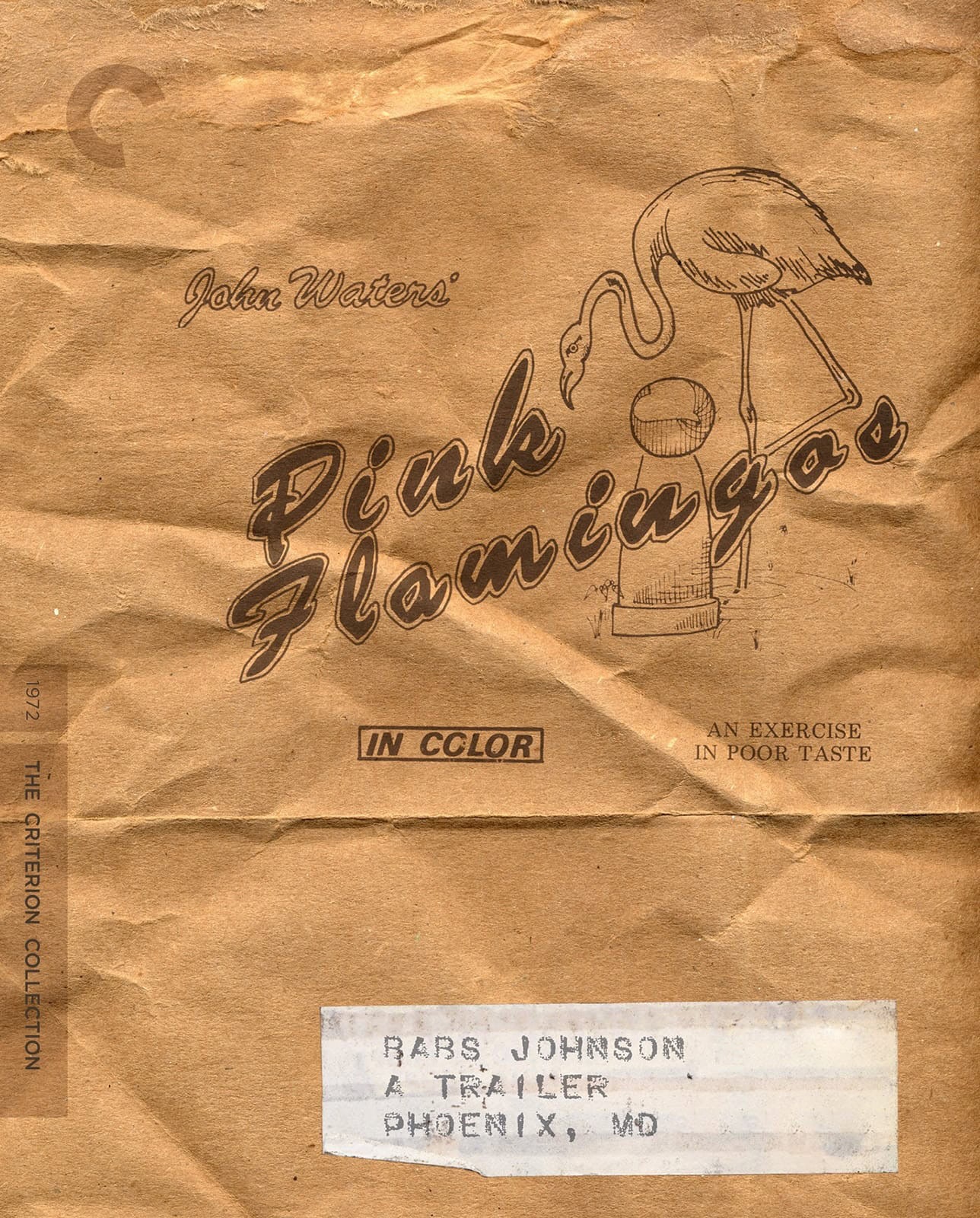
Rounding out the package are the deleted scenes presented as part of the film’s 1997 re-release, the very grindhouse-friendly theatrical trailer, a booklet featuring Cookie Mueller’s memories of the making of the film, a characteristically sensational analysis from critic Howard Hampton, and an amusingly petite “Pink Phlegm-ingo Bar Bag.” Oh, and a piece of inner sleeve artwork that truly deserves to be hung in a museum.
Overall
Criterion reaffirms their commitment to the Pope of Trash’s oeuvre with a definitive release of John Waters’s seminal sensation. It’s all that and a suitcase full of eggs.
Since 2001, we've brought you uncompromising, candid takes on the world of film, music, television, video games, theater, and more. Independently owned and operated publications like Slant have been hit hard in recent years, but we’re committed to keeping our content free and accessible—meaning no paywalls or fees.
If you like what we do, please consider subscribing to our Patreon or making a donation.